hope this helps! Good luck and God bless!
My Life as a Med Student and the things in between. Animo La Salle!!!
Saturday, March 22, 2014
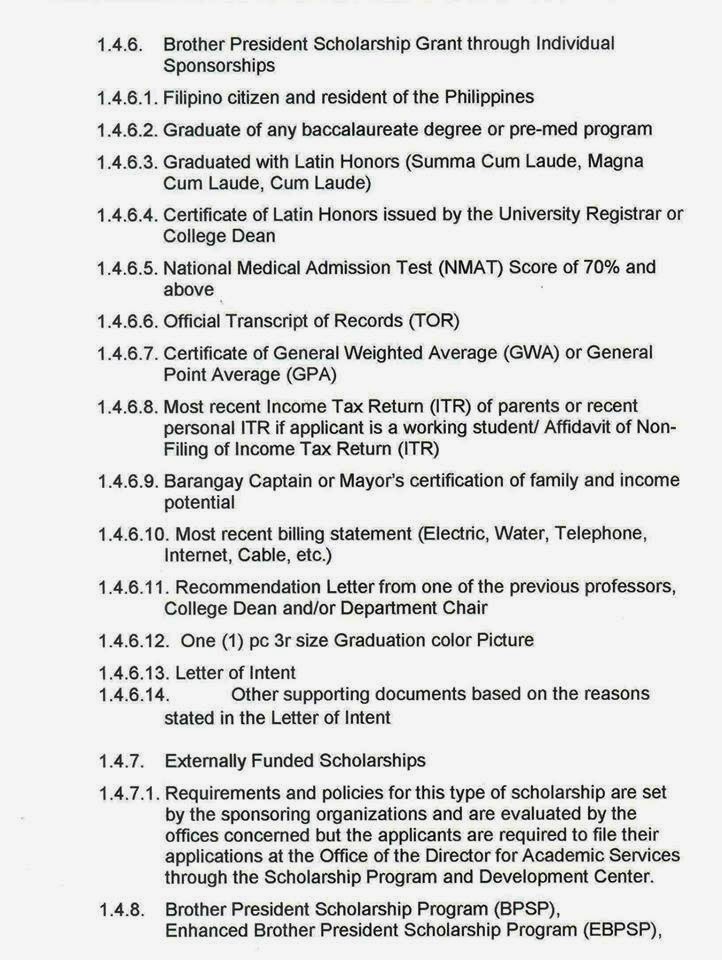
DLSHSI Scholarship Application Ongoing for SY 2014-2015
Hey guys, here's a sched of the application periods as well as the guidelines. :)
hope this helps! Good luck and God bless!
Sunday, March 2, 2014
Aaaaaand....I AM BACK FROM THE DEAD!
Hello friends and anons!
I’m so so sorry if it took me this long to write again.
This 2nd year was just...tiring.
No. "Tiring" just doesn't cut it.
Exhausting. Draining. Spent. Consumed. Jaded. Tired.
Weary.
It’s true what the upper years told me during my 1st
year.
Enjoy it while you can.
The first year in Medicine was a stroll in the park. This
year was a stroll through the gates of Mordor.
I wouldn’t doubt it for a second if the upper years told me that the 3rd
year (and succeeding years in Medicine) would just get worse.
The reason why it took me so long to write again was that
I was struggling. The subjects were harder,
the workload/ study load was immense, the lecturers were even more
strict, and, everything was just happening too fast.
This year, exams were all held in one week (most of the
time). Unlike last year where one subject would be scheduled on Monday, another
on Friday, or whatever random day they picked, this year, everything happened
in a week. Usually, on one day, there would be at least 2 subjects; one in the
morning, one in the afternoon. It would have been fine for just one day, but,
by the 2nd day, you’re just waiting for the week end.
I was studying my ass of as usual, and I thought that it
was enough to get even a decent grade in that particular subject.
Exams were done. Results came out. Voila. I failed.
I got depressed, I went on an eating binge, and threw
myself a small pity party to celebrate my failure.
And just like that, the party just started.
I failed another exam. And then another. And then
another. Sometimes, some of my exams
would just resurrect from the dead due to the MPL. I’d rejoice in that, but, I
knew that I wasn’t doing as well as I should.
That’s one of the things I noticed with these failures.
They tend to haul you down, make you rearrange your priorities and alter your
view on what’s enough. Your standards get lower, you sacrifice quality for
quantity, and you just keep grabbing at loose ends and find yourself empty
handed after it all.
Before, I studied to get to the top, challenging myself to just do better. Now, its more of study to get that passing
grade. Even before the exam is done, I would be computing for the MPL (adjusted
score) at the margins of my paper. I’d
look over my answers, make a quick calculation, and breathe a sigh of relief
when I see that I know enough answers to save me for this exam. Quietly, I say
a little prayer, and then promise to myself that I’d study harder next time to
redeem the really bad grade.
And then it happens again. You get caught in the vicious
cycle of just trying to get by. Sometimes you do, sometimes you don’t. But
ultimately, what happens is you just get stuck doing just enough.
Im not saying that if you keep failing, it means you’re
not learning, or you’re lazy, or whatever.
It’s the effort that went behind it. If you poured
everything into learning and studying for that exam and and still came up
short, it just means that you have to try harder. Or smarter.
When I failed my exams, I tried studying harder. I stuck
with the same study routine I had in my first year. Then I failed again.
I continued doing the same thing over and over again,
expecting a change somehow. And then it
struck me, its not going to work.
![]() |
| https://fbcdn-sphotos-g-a.akamaihd.net/hphotos-ak-ash3/35565_296671800447151_1518836922_n.jpg |
Fine, Pinterest was my go to place for inspiration. And
this just struck a chord. I tried different study methods. I worked with index
cards, typing my own reviewers, reading, listening to recordings, etc. Up to
now, I still haven’t figured out the best way for me to study. But Im doing
better. Much better than before.
My grades improved slightly. I was still failing a few
exams here and there, but I was getting used to it in a sense that it wasn’t so
depressing enough to stop me from studying again with full force.
I used to be so envious of several of my classmates who
seemed to get the hang of everything. They were getting really good grades,
they were asking all the right questions during discussion, they were LEARNING.
While some of us were on the sidelines trying to learn how to tie our own
shoelaces, the toppers ( classmates who were excelling) were running about,
executing complex drills and the like.
I knew that they studied before hand, that they took the
time to review their basics, understood it, and just related it the present
lesson, but, I just couldn’t do the same thing.
No matter how hard I tried, I just couldn’t seem to get
the hang of it. I wanted to become the best, I wanted to perform and excel, but
I just didn’t know how.
I still don’t know how. But one thing’s for sure, I.
WILL.NOT.SETTLE.FOR.COMFORT.OR.MEDIOCRITY.
I may not be one of the smartest, or brightest in the
class. But I will not settle for just being one of those people who tell
themselves that “Its ok if I don’t do well now, I’ll just do better in the
future, when Im a doctor. At least I’ll get to do things my way.”
Never become these people. Its tempting to think about
it. Its even more tempting to live it and accept it as it is because so many
people are doing it. But don’t do it.
I’ve met a few people , and some lecturers who proved
this wrong. They may not have been the smartest of the bunch, but they worked
like hell to get where they are.
We should do the same. We’re going to be doctors. Nobody
wants a half-baked doctor.
Sunday, October 27, 2013
Saturday, June 22, 2013
This is Amazing!
The wonders of modern technology. This is inspiring. :) gotta study harder!
http://www.carbonated.tv/news/doctors-inject-hiv-into-6-yearold-girl-youll-want-to-know-why
Tuesday, June 11, 2013
Friday, May 31, 2013
Thursday, May 30, 2013
Friday, May 24, 2013
ASK ME/ CONTACT ME
| http://forum.tis.edu.mo/yu/wp-content/uploads/2012/08/contact-me1.png |
or you can post your questions and comments in the FORUM.
Saturday, May 18, 2013
Friday, May 17, 2013
FELLOW BATCHMATES! Advice for Incoming 2nd Year
SUPERULTRAMEGA THANK YOU TO ONE GENEROUS, SELFLESS INCOMING 3RD YEAR STUDENT WHO WISHES TO REMAIN ANONYMOUS.
YOU. ARE. A. LIFE SAVER!!!!
| http://cdn.memegenerator.net/instances/400x/31322935.jpg |
Disclaimer: Each student has his/her own strengths and weaknesses. Some tips mentioned here might or might not work for you. The tips are based on what I experienced last school year, and there could be changes this school year (such as number of evaluation exams, coverage, etc.).
PATHOLOGY
· There
are only 8 evaluation exams the whole school year, plus 2 semestral exams and 1
final exam. The coverage of each evaluation exam is usually very long. Better
prepare several days before the actual exam.
· You
need to see the specimens/slides to understand what is being described in the
lecture. Just reading the PPTs or your books might just confuse you.
· Past
evaluation exams could be helpful if you ‘dissect’ each exam. Some questions
could be repeated as is, but they usually change the pattern of the questions
even if they are based on questions asked in the past evals.
· Exams
are usually based on the lectures. The chapters in the Pathology book are very
long, so if you don’t have much time, use the latest PPTs or handouts they
give. Do not rely on past ‘tranx’ if you have the updated lectures with you.
· Watch
out for Doc Renan Navarro’s exams because they are very confusing, so you need
to study EVERY detail.
· Answer
your laboratory manuals whenever you have time. Most students answer them when
the deadline is near, adding unnecessary stress.
· In
Pathology lab sessions, have an atlas available (or other resources) so that
you know what to look for in the slides.
· Study
your evaluation exams for the semestral exam. Dissect them for better
understanding. For the final exam, study all your evaluation exams and your
semestral exams.
MICROBIOLOGY
· Evaluation
exams are usually based on the lectures given. The coverage varies per exam
(there could be as high as 9 lectures, and could be as low as 3 lectures)
· They
do not give their PPTs but they give handouts.
· Watch
out for Dra. Padla’s and Dra. Mendoza’s exams. They are usually difficult and
confusing. Dra. Mendoza usually gives questions based on cases, therefore do
not rely on memorizing information.
· Dra.
Barzaga’s exams are usually the “life savers” because she frequently gives easy
questions.
· Every
after Dra. Padla’s lecture, there will be a 10-item quiz.
· The
semestral and final exam questions usually are NOT based on past exams.
· They
RANDOMLY check the laboratory manual during lab sessions. Answer them as soon
as possible. Once the names of the ‘lucky’ students are announced, they are
required to pass the lab manual on the same day or the following day.
PHARMACOLOGY
· Exams
are mostly based on the lectures. Watch out for questions from Dra. Dela Cruz
and Dra. Alvero. The questions (and choices) are usually tough and confusing.
· Attend
each lecture. They give bonus points for attendance and add them to the evals
scores.
· Dra.
Aguinaldo usually gives the relatively easier questions, but you still have to
master her lectures because usually her lectures involves a lot of drugs.
· They
usually do not ask about dosages. Focus more on their classification and primary
action.
· Exemption
from the final exams if you reach 85%
· The
amount of material you have to study may be very overwhelming. Try to utilize
various strategies in studying instead of just doing passive reading, such as
tables and flash cards.
· Do
not study overnight. It may work in the other subjects but in Pharma, it simply
won’t.
· Keep
quiet during the lectures of Dra. Dela Cruz. She does not tolerate distractions
during class.
COMMUNITY MEDICINE
· Do NOT
take this subject for granted. That was the mistake of most of my batchmates,
and ended up getting low grades. This subject is totally different from Commed
in the first year.
· Get a
copy of the past evals and try to answer the questions on your own. Familiarize
yourself with the process, the computation, etc. Do not just read passively.
· There
are only 6 evaluation exams.
· Exemption
is 80% (including the research paper grade)
· Do
not rely on the research paper to pull your grades up. The bulk of the grade is
still based on your evaluation exams.
· Attend
all of your preceptorials. They check the attendance. Preceptors also base
their grade on the attendance and performance during the preceptorials.
· Quizzes
about the research paper may be given before the schedule preceptorials.
BIOETHICS
· Analyze
the past evaluation exams to familiarize yourselves with the pattern of the
questions. They may or may not repeat the questions as is.
SURGERY
· Exams
are usually based on the lectures, but some professors get their questions from
the book. Dissect past evaluations. They are usually helpful.
· Exemption
is 85%
· Watch
out for the topics about Physiologic Monitoring and Surgical Complications –
they are the most difficult topics (at least for me) in 2nd year
Surgery.
· Most
students choose to not attend Surgery classes because they consider it a “minor”
subject (and prefer to do something else), but if you really want to learn and
not just get a passing mark, do attend. Learning should not only be for exam
purposes.
MEDICINE
· Most
exams are based on the lectures, but if you have time supplement it with your
book. They may or may not repeat questions.
· The
neuro module is the most difficult based on my experience.
PHYSICAL DIAGNOSIS
· Dr.
Versoza once said that no one fails in PD (except one who was caught cheating
during a return demonstration). Do not take this one for granted, though.
· Exams
are usually based on the lectures, but other professors may use other resources.
If s/he did not mention the resources s/he used, you may just ask him or her
about it.
· There
are practical exams wherein you demonstrate physical exam techniques to a
preceptor. Beware of ‘terror’ preceptors. Some preceptors though remain silent
all throughout the practical exam and just observe.
· Master
the techniques and be familiar with the rationale behind each technique.
OBSTETRICS
· We
had pre-tests and post-tests almost every meeting.
· They
usually change topic assignments for professors every year, so do not rely on
past evaluation exams. They usually do not repeat questions.
· Use
your book when studying. The lectures are usually not enough to get a decent
grade in the evaluation exams.
· There
are only 3 evaluation exams.
· Exemption
is 85%
· They
give refresher exams for those who fail, but the total number of items is
reduced by 50% and you have to pass the refresher to get 75%. If you fail, you
retain your previous score.
· They
do make several new questions for the final exam.
PEDIATRICS
· We
had only 2 evaluation exams. Our first evaluation exam covered 9 long lectures,
so study beforehand.
· You
have to memorize a lot of normal values (ex. head circumference depending on
age, weight depending on age, etc.).
· Past
evaluations could be helpful to determine the pattern of the questions, but
they usually do not repeat questions as is.
PSYCHIATRY
· Three
evaluation exams and one final exam.
· Usually
exams are based on the lectures, while some questions may be lifted from the
book.
· Make
sure to attend special activities they hold (film showing, role play, etc.) to
avoid the hassle of being rescheduled to perform those activities.
· Final
exam: study your past evaluation exams
General Tips:
· Do
not rely on past ‘tranx’. Use the latest lectures if available. Past tranx
could be incomplete or may contain factual errors. Better yet, use your books
if you do have the time.
· Past
evals, if used correctly, could help a lot for your evaluation exams (except
Microbiology and Obstetrics). Do not just memorize the questions and answers.
· You
do not have to purchase all of the books, because usually there is not enough
time to read through them. I recommend having the Internal Medicine
(Harrison’s), Surgery (Schwartz’s), and Obstetrics (Williams) books for the 2nd year.
Better yet, just get ebooks and be used with studying on a tablet or PC. I used
to prefer studying using a physical book or a printed handout, but eventually I
got used to studying using the digital formats. It saved me a lot of money,
paper, ink, and space.
· Subjects
with exemption from final exam: Pharmacology, Community Medicine, Bioethics,
Surgery, Obstetrics
· Exams
are usually given within a week. Some days might even include four exams in one
day. Manage your tasks wisely.
Wednesday, May 15, 2013
PRICES FOR FIRST YEAR MED BOOKS
You can buy these at the ground floor of the Angelo King Building, or during your LOAD orientation. :)
Got this from the a batchmate of mine. :)
FIRST YEAR SUBJECTS: Advice, Tips
PRACTICAL TIPS FOR 1ST YEAR SUBJECTS:
Hahahaha, maybe some of you might feel let down just reading inspirational self help stuff, so here are a few tips for studying/ passing some of the subjects during your first year:
1. ANATOMY
For HISTOLOGY, make sure you take the time to view the slides during your lab sessions, some classmates may like to help out and picture the slides, put them together in a little powerpoint presentation, that's ok, but make sure you put in little time to review them still. Take note of specific characteristics of the specimen, dont just wander around the slide and point out random stuff.
READ THE BOOK. Yup, the book Gonzales and Esteban. The lecturer takes everything from there, word for word. Sometimes he gets a little tricky with the questions, so be sure you've read each chapter. The chapters are pretty concise, but there's a tendency for some info overload after each lecture. Make sure to study them well because they sometimes have pre and post quizzes.
For EMBRYOLOGY, read read read read Langman's Embryo and the Embryo notes from the CD (the CD comes with the Dissection Lab Manual that they will require you to buy at the start of the year). Langman helps you out with the flow while the Embryo notes on the CD helps you out with the genes that you will have to memorize.
For GROSS ANATOMY, for certain professors, study the powerpoints, for others, study Snell. Absorb, memorize, understand the lectures. In dissection, one professor likes it to be done this way:
1. Study the topics from the book~ understand and remember the surrounding organs, their connections with one another, their boundaries, etc.
2. From the book, look for it in the atlas based on what you know about it.
3. From the atlas, find it in the cadaver.
This professor doesnt like students heading straight for the cadaver, second guessing if this is the organ, or if you cut it out already, etc. Armed with what you know, you should have a good idea where specific organs, muscles should be. He'll go around each team asking the blood supply, the importance of this, the importance of that, etc. He's very, very, VERY thorough with his questions. By the end of the session, you can actually feel the life force drained out of you from all the tension and the mind boggling questions.
2. PHYSIOLOGY
Physio works extremely well with Anatomy. Once you understand your anatomy, Physio becomes pretty easy and vice versa. I recommend reading Guyton. Its simplified, and covers certain topics over and over and over again. For me, the hardest topics were Respiratory and Cardio Physiology. Study on that.
3. BIOCHEMISTRY
Biochemistry uses a lot of references. Different books for different lecturers. Some prefer Harpers, some prefer Devlin, some focus more on their powerpoints since they used A LOT of references.
NOTE: THERE ARE NO SHORTCUTS IN BIOCHEMISTRY. YOU HAVE TO MEMORIZE AND UNDERSTAND IT ALL. The enzymes are especially tricky...those evil little suckers....
For these last two subjects, never, ever, NEVER EVER EVER EVER underestimate them.
4. COMMED
No shortcuts with this either. Study or die. That's about it.Try to do well in all exams, the earlier the better, because their exams are hard and unpredictable at times.
5. PSYCH
Attend EVERY lecture. They check the attendance, there are recitations, there are quizzes, there are activities. Don't skip any lecture. You can either read the book, or follow along with the lectures, memorize and understand everything. There are only 3 evaluations, followed by Finals. Try to do well in all of them.
Monday, May 13, 2013
Wednesday, May 8, 2013
SURVIVING YOUR FIRST YEAR IN MEDICINE: tips and motivation
So. I survived my first year in Medicine.
http://www.wallpapersshop.net/wallpaper/this-is-sparta-300-king-leonidas-warrior-sword-shout-rage/
I was merely a few days away from freedom, and the final week was just pure torture. Everybody was feeling it, everyone was tired, sleepy, cranky, and just ready to get the exams over and done with. I wouldnt be surprised if a lot just kinda gave up on trying to finish reviewing everything, because, honestly, everyone seemed too tired to care.
BUT, we were always reminded, "ONE.LAST.PUSH."
One last push, and then summer vacation.
One last push, and you could burn all your reviewers and dance for joy.
One last push, and then you could sleep and eat as much as you wanted.
I was lucky though, I was exempted from several of the final exams, and it was such a relief that I didnt have to review all that bull-- and just relax at home.
I salute those who are still going to take the final exams and even removals. I seriously dont know how they hve the willpower to study all those topics all over again.
Honestly, I think that those who took the finals and removals have a headstart for the 2nd year, meaning, they have experienced the failures necessary to make them stronger and sturdier for the upcoming years.
I'm happy that I didn't fail any of the major exams in any subject this year, but I'm terrified about the upcoming failures I will be experiencing in the following years.
I don't know how to cope with failure. The one time that I "thought" I failed in an exam (I learned later on that I passed since they lowered the passing rate), I reacted like an immature piece of (expletive). I was depressed for several days, I was always thinking about how I would tell this to my parents, I thought how stupid was I to fail an exam?
I know, it seems a bit extreme for one exam, but Im just describing how terribly ill adapted I was to failure.
Looking back on the past year, I think I could have handled certain situations a lot better, especially in my academic life... so here are a few tips and words of wisdom to remember in surviving your first year:
1. In situations where you fail, remember this...you are not stupid, you are just adjusting.
This is Medicine. This isnt like your elementary/highschool/ college years where you could sleep, eat, poop normally, study for an exama night before and pass. There will be classmates who are smarter than you. They will ace every exam, every subject, they will UNDERSTAND EVERY WORD THE DOCTOR/LECTURER WILL SAY DURING LECTURES ( this is an astounding feat...), in all aspects, they are the ones who Darwin described when talking about survival.
BUT, then there is the rest of the class. Try talking to them. You will not be alone in your struggles. Take the time to look around and see that not everyone is doing so good in class. They may be honor students, summa cum laudes at their school, the math whiz, the top notcher in the Nursing/ PT/ RT/ OT/ Pharma boards.
Remember, this is Medicine. What matters is how YOU answer the challenge.
In the end, its just YOU who will be facing the patient.
It will be YOU handling the situation when you come face to face with a dying patient.
Do what you have to to survive (except cheat, and other dishonorable means) in Medicine. Challenge yourself. Stop comparing.
2.Study when you have the free time.
Believe me when I say this. If the exam is a week away and you have a free day/ ISP (individual study period)/ weekend---study. One night--even one day--is not enough to cover all the topics you need to study for the upcoming exam.
3. When faced with setbacks (take note...setbacks, not failures):
4. Within your first few months, try to find out your most efficient study habits.
http://www.wallpapersshop.net/wallpaper/this-is-sparta-300-king-leonidas-warrior-sword-shout-rage/
I was merely a few days away from freedom, and the final week was just pure torture. Everybody was feeling it, everyone was tired, sleepy, cranky, and just ready to get the exams over and done with. I wouldnt be surprised if a lot just kinda gave up on trying to finish reviewing everything, because, honestly, everyone seemed too tired to care.
BUT, we were always reminded, "ONE.LAST.PUSH."
One last push, and then summer vacation.
One last push, and you could burn all your reviewers and dance for joy.
One last push, and then you could sleep and eat as much as you wanted.
I was lucky though, I was exempted from several of the final exams, and it was such a relief that I didnt have to review all that bull-- and just relax at home.
I salute those who are still going to take the final exams and even removals. I seriously dont know how they hve the willpower to study all those topics all over again.
Honestly, I think that those who took the finals and removals have a headstart for the 2nd year, meaning, they have experienced the failures necessary to make them stronger and sturdier for the upcoming years.
I'm happy that I didn't fail any of the major exams in any subject this year, but I'm terrified about the upcoming failures I will be experiencing in the following years.
I don't know how to cope with failure. The one time that I "thought" I failed in an exam (I learned later on that I passed since they lowered the passing rate), I reacted like an immature piece of (expletive). I was depressed for several days, I was always thinking about how I would tell this to my parents, I thought how stupid was I to fail an exam?
I know, it seems a bit extreme for one exam, but Im just describing how terribly ill adapted I was to failure.
Looking back on the past year, I think I could have handled certain situations a lot better, especially in my academic life... so here are a few tips and words of wisdom to remember in surviving your first year:
1. In situations where you fail, remember this...you are not stupid, you are just adjusting.
![]() |
| from soulhunting.tumblr.com |
This is Medicine. This isnt like your elementary/highschool/ college years where you could sleep, eat, poop normally, study for an exama night before and pass. There will be classmates who are smarter than you. They will ace every exam, every subject, they will UNDERSTAND EVERY WORD THE DOCTOR/LECTURER WILL SAY DURING LECTURES ( this is an astounding feat...), in all aspects, they are the ones who Darwin described when talking about survival.
BUT, then there is the rest of the class. Try talking to them. You will not be alone in your struggles. Take the time to look around and see that not everyone is doing so good in class. They may be honor students, summa cum laudes at their school, the math whiz, the top notcher in the Nursing/ PT/ RT/ OT/ Pharma boards.
Remember, this is Medicine. What matters is how YOU answer the challenge.
In the end, its just YOU who will be facing the patient.
It will be YOU handling the situation when you come face to face with a dying patient.
| http://pinterest.com/pin/247557310737728706/ |
Do what you have to to survive (except cheat, and other dishonorable means) in Medicine. Challenge yourself. Stop comparing.
2.Study when you have the free time.
Believe me when I say this. If the exam is a week away and you have a free day/ ISP (individual study period)/ weekend---study. One night--even one day--is not enough to cover all the topics you need to study for the upcoming exam.
| http://media-cache-ak1.pinimg.com/550x/71/a1/37/71a13761fdcc0dc0192bc982f1625025.jpg |
3. When faced with setbacks (take note...setbacks, not failures):
| http://pinterest.com/pin/247557310736795482/ |
![]() |
| http://edufastonline.blogspot.com/2012/09/your-learning-preference.html |
Know whether you best retain info by reading, listening to lectures, studying while moving around, etc.
If you dont know, try experimenting in your first few months. After a few exams, you'll finally settle into your natural academic groove for studying.
5. Don't be afraid to FAIL.
I've yet to successfully pick up on this, and one I'm hoping I can conquer this coming 2nd year in Medicine. If you've already covered this one, good for you. Hahahahaha
What doesn't kill you makes you stronger.
Medicine is like Jigsaw in the SAW movie, you never know what you're getting into, or what you have to exchange for freedom/ success/ a passing grade.
I wanna play a game...its called....STUDYING.
Thursday, May 2, 2013
DLSU-D AND DLSHSI'S STRAIGHT MED PROGRAM
Hey guys, check out DLSHSI'S and DLSU-D's new vid. :) credits to the school for making this vid. :)
Sunday, April 14, 2013
UPDATED: Med Books for Sale - ALL SOLD
Hey guys, I'm selling my 1st Year Med Books :)
For the original prices, these are the prices that were sold to me at school, or online.
Moore, I hardly used it this year because I was more comfortable with Snell. Other classmates used Moore more since it was more detailed and comprehensive when it came to discussions.
If interested, kindly message me here, first come, first serve. :) I can meet you guys up at school if you'd like or I can have them delivered to you via LBC. :)
For the original prices, these are the prices that were sold to me at school, or online.
Moore, I hardly used it this year because I was more comfortable with Snell. Other classmates used Moore more since it was more detailed and comprehensive when it came to discussions.


If interested, kindly message me here, first come, first serve. :) I can meet you guys up at school if you'd like or I can have them delivered to you via LBC. :)
Safety and Security in DLSHSI
Ok, for those of you who have heard the news about the shooting, robbery/ burglary in Villa Nicasia, here's my opinion on the matter.
First off, I extend my deepest condolences to the family of this student.
For privacy purposes, I won't mention his name. I didnt get the chance to know him since he was several batches higher than me, and what I heard, I just heard from classmates, and those who lived near the site where the incident happened. Most of the details are in the news.
Secondly, for those of you who are questioning whether DLSHSI is safe, especially the Villa Nicasia area, think about all the other places that you consider safe. Are they, really?
DLSHSI itself is perfectly safe, with security guards at every station, every entrance and exit. Outside of that, it is all dependent on the authorities of Dasmarinas.
I personally think that those in power have not made the necessary steps to secure the area, or make the proper arrangements/ improvements considering that De La Salle is a highly populated area. The lack of streetlights, the large holes in the sidewalks, the open creek to the side of the walkway--these are things that could have easily been fixed, but, no changes have been made in the past year. I personally would like to change that, but in all honesty, I dont even know where to start with this one. Hopefully this year, since elections and all, they can do something about the periphery of DLSHSI.
With regards to Villa Nicasia, everyone has the right to question the security of this place right now, considering that other robberies/ burglaries happened within this year alone. Most of these incidents happened in the dorms farther away from the entrance to Nicasia. Some speculate that most of the criminals enter and exit from behind the village because of the empty lots nearby. Others also speculate that it was more of an inside job or so, rivalries, fights between students, fraternities, etc. Others speculate that the lenient procedures implemented by Nicasia for entry into the village was the reason. I mean, any car can get into Nicasia just as long as you either have a sticker, or Php 20.00. Yup, they don't ask for your ID when outsiders come in. They just ask for Php20.00 and you are free to roam around the place. They just assume that everyone who enters Nicasia are just there to look at dorms, and inquire.
It was an oversight on their part, and one, I hope, they would correct this year.
One more point that I'd like to make. I've been reading on comments from people on facebook and other forums that they're doubting if they made the right choice to apply to DLSHSI because of the safety issues.
Some are even correlating the quality of education to the quality of safety that the school is providing. That is completely irrelevant.
Well, give me a school that is 100% safe. Is there? Everything you do has corresponding risks. The risks can be lessened by the cooperation of the city authorities, the school, AND the students. If its late at night, and you still want to go out to study or go on a random road trip, its fine to do so...just as long as you take the proper precautions when going out.
Always travel in groups.
Don't stay out too late.
Always let someone know where you're going.
Be street smart.
In my undergrad, our area was a hotspot for crimes like that--holdups, salisi gangs, robberies, break ins, shootings, rallies, frat fights, but in my 4 years there, I never once experienced it (thank God). Other schools have experienced similar incidents like the ones you have been hearing about, and they can do only so much to protect their students. Much like DLSHSI, the safety of the students are always a priority, and they're doing their best to respond to these issues. But the blame/bulk of the responsibility doesnt rest solely on the school.
It needs the cooperation of everyone.
Friday, March 22, 2013
UPDATED: Med Books for First Year- What You Really Need to Know
Note: Im also selling my old books, for those interested, here are the prices :) http://hopingtobeapinoymedstudent.blogspot.com/2013/04/med-books-for-sale.html
Ok, this was one problem that i encountered during my first year, which books to buy, the prices, which ones did the professors really use, etc?
FIRST, I would advise you NOT to buy all the books in one go, unless you know you are a bookworm, and you're studying habit involves reading every chapter instead of using reviewers.
Here are some books that I found most useful during my first year:
- ANATOMY: the doctors use both Snell and Moore. Certain doctors rely solely on Snell, others on both. One book that you should buy is Netter. Cant Live without it, extremely useful during dissections, and if you area visual learner.
- BIOCHEMISTRY: you can use Harpers or Devlin. Harpers is straight to the point, a bit difficult to understand, but the chapters are short. Devlin discussesthe topics well, but the chapters are a bit long, so if you dontmind reading a lot, this is the book for you. One book that got me through biochem was Lippincott. Extremely easy to understand and a lot of pictures too. There's another booktoo, i'll try uploading it when i can, they call it Digging Up the bones for Biochem. Very very VERY helpful, short, concise, pretty much like Biochem for Dummies.
-PHYSIOLOGY: Guyton or Ganong. guyton is easy to understand but there are a lot of chapters to cover pertopic even if they're short. Its also non-science student friendly. Review of Medical Physio by Ganong is just what it says it is, its a REVIEW. Thats why its a bit difficult to understand, but very concise with their discussion. I used Guyton a lot.
- ANATOMY-Histology and Embryology.
For histology, you must have an atlas for when you're looking at slides in microscopy. You can go for Wheater's, or Di Fiore. Personally, i liked Di Fiore, even though ididnt have one. By the time i knew di fiore was pretty good, i had already bought Wheaters. :)) most BS Human Bio students from La Salle Taft were already using this~nakitingin lang ako.
Aother thing, you guys should buy the Histology book by Dr. Edgardo Gonzales, they sell it at school or cem bookstore. Doc Ed is a doctor lecturer so its really important to get this book. Everything he teaches is in this. Hahahaha hope you enjoy his class!
Hahahahaha For Embryology, Langman's was pretty good with the discussions. And if you can get a copy of Kates- kind of like a booklet/reviewer made by the upper classmen and Doc Jah, its pretty good, and covers everything. Lang,an lacks certain info, while the Kates booklet lacks the small discussions of the processes, so i guess its better ifyou buy them both.
Ummm, cant remember what else, lemme know if you guys need more info regarding some other books. :)
Also, here's a link to Pinoy.Md of people selling second hand med books. Much much cheaper. :)
http://pinoy.md/ipb/index.php?showtopic=10098
Thursday, March 21, 2013
Subscribe to:
Posts (Atom)