Showing posts with label DLSHSI. Show all posts

Friday, May 20, 2016

Flashback Friday

Flashbaaaaack from 3rd year, skills lab with ze batchmates. Everyone had to partner up, but aince we were odd numbered, i was joined in a grouo of 3. The dr. In charge said my veins were peominent and straighter so i should volunteer both my hands.

Mygaaaaahd. I nearly passed out from the pain. I had to walk like some funky dinosaur with my hands raised to my chest in pain. I spent a week and a half with these bruises before they faded.


Tuesday, April 26, 2016

In Preparation for Your Junior Internship

Junior Internship started in a daze.

I hated the feeling of terror, and feeling of impending doom since we knew nothing (Jon Snow ang peg...) about junior internship.

First off:

WHAT DO YOU NEED FOR YOUR JUNIOR INTERNSHIP/ Clerkship?

It actually depends on your rotation, as I found out. Most of my classmates resorted to borrowing from other rotations, but you must at least have your basics which are:


  • Stethoscope
  • BP App with Adult cuff (recommending Baxtel since its easier to find a pedia cuff for it instead of the Welch Allyn), and pedia cuff(if rotating in Pedia)
  • 70% Rubbing Alcohol (you frequently need to keep your hands clean, as well as your instruments)
  • thermometer
  • Penlight
  • Watch (for counting your RR and HR)
  • Face Masks (comes in handy when rotating in Pedia since kids practically cough in your face all the time, or when your post duty and you're just too tired to brush your teeth
  • Personal stuff that come in handy when youre starting to feel the 24-29 hour grime: wet wipes, hankies or towels, tissue, toothbrush, small packet of toothpaste, powder


For our rotations in DLSHSI, we needed the following in addition to the basic set:

OB: Tape Measure (to get the fundic height)
Commed: Neurohammer for OPD
ENT: Bandage scissors, Kelly, Mayo, Micropore, Otoscope (you can borrow from each other)
Ophtha: Ophthalmoscope, lots of rubbing alcoholc (when its the season for sore eyes)
Psych: Your patience.
Ortho: Bandage scissors, Kelly, Mayo, Iris, Micropore
IM: BP App with Adult Cuff, rubber shoes (hahahaha, for running in when theres a Code Blue ongoing), neurohammer
Surgery: All the scissorsssssss, micropore, 
Pedia: Pedia Cuff (some are compatible with Baxtel, ranges from 250-350 in price)
Books you say?

OB still uses Williams latest edition + tranx for their exams.
Commed- still unpredictable. Base it on your previous lectures/ tranx
ENT- Probst, and lectures
Ophtha- lectures
Psych- Kaplan and Sadock, baby book was extremely helpful
Ortho- lectures
IM- IM Platinum, Harrisons
Surgery- lectures + Schwartz
Pedia- lectures > Nelson's, Nelsons Essentials

SCHEDULE:
PREDUTY: 7AM TO 5PM
DUTY: 7AM TO 7AM THE NEXT DAY
POST DUTY: 7AM TO 12NN

Kinda confusing? Me too. I couldnt wrap my head around the status thingies. but it goes like this:

for example. Preduty is Monday, you stay at the hospital from 7am to 5pm, then go home.
Tuesday is duty, so you clock in at 7am, then your shift lasts until 7am the following day.
Wednesday, from 7am (immediately after your duty shift) you are post duty, and stay until 12nn.

Preduty: Do your usual duties, whether you are in OPD, the wards, or special rotation, do your paperworks, monitor patients, and whatnot.

Duty: You do the same thing as preduty, but loooonger.

Post duty: Finish up your paperworks. Paperwork? Updating abstracts, finishing your wardwork paper on the patient.

Although these tasks are different from rotation to rotation, there are some rotations wherein you do nothing much, and let preduty people take care of the tasks for that day, and then you start by 5pm. 

If you need tips per rotation, just email me. some of the details might be different during the actual rotation. 

Junior Internship (Super Late Post)

The [ Junior] Intern

Oh, by the way if you'd like a few tips on junior internship, read this: JUNIOR INTERNSHIP

I came into this year thinking that I’m 1 year away from graduating, that it would be busy, fast paced, and would pass by quickly enough.

Looking back on the past 8 months, I realized that I learned so much in such a short amount of time, but also realized that I had so much more to learn.

These past 8 months, and 4 different rotations made me realize the following:

1.      If you thought that you were tired, and you cant go on anymore, youre wrong. There will always be that extra hour of energy to finish that last few pieces of paperworks and cases.
2.      There’s nothing that 10 billion cups of coffee and energy drinks can fix on a long (very,very, very long) duty day.
3.      Team work will be the only thing that can help you get through toxic duty days.
4.      There is an amazingly large difference between the books/lectures and actual medical practice in the hospital. So when you see a consultant/resident doing their rounds, jump up and join them.
5.      Hardwork beats being smart anytime. But putting extra effort in studying makes it extra better.

I overheard this during my third year of med school. I am 120% positive this will be true when it’s my turn as the intern.
(Drawn in the style of XKCD comics)
http://medsketches.tumblr.com/post/60258641113/i-overheard-this-during-my-third-year-of-med


6.      Internship will break you, destroy you, harden you, and then gradually build you up, make you, mold you, and turn you into the most amazing, efficient intern ever [hopefully].
7.      Internship teaches you the difference between working with friends, and working with co-interns. Work is work.
8.      You will constantly be amazed by the wonders of the human body.
9.      Situations such as sickeness and disease will show you the best, and the worst in people in the hospital.

10.  Medicine isn’t as glamorous as everyone thinks...


OB GYNE

This was probably the best and worst time of my JIship. There is one thing that 3 years of med school wont teach you and prepare you for—endurance.

Mental. Physical. Emotional. Endurance.

This was like jumping off a cliff into shark infested waters while you were bleeding.

The first month was concentrated at the wards while the 2nd month consisted of special rotations such as our rotation in GEAMH, OB Ultrasound, and OB Patho.

Que horror. That first month was something I dreaded and hated to the fullest extent of my being. I did not understand what I was doing since it was my first time to go on duty. The concept of preduty, duty, post was foreign, and I really didn’t understand what I was supposed to do as a clerk, coupled with extremely angry residents. I understand their anger and confusion that their new JIs know nothing about OB, and didn’t know how to actually present cases/ endorsements.

Everything was chaos every day for the first few weeks and sleeping became a problem. I had constant nightmares and remembered dreaming that I was on labor watch at the dorm. I would find myself waking up with my hand propped up on a pillow imagining that I was on labor watching, and wishing that she’d just undergo a CS instead.

The duties gradually became better. I started to understand what I was doing. The topics became much more understandable, and the stress levels were more manageable. But then again, it still remained very difficult for everyone. The endorsements were brutal. These 8am meetings at the SGD were absolutely brutal, and you just wished that you never had been decked with patients. I was lucky that my resident buddy was the best, and would teach me a few minutes before endorsements just so that I wouldn’t be tortured in front.

The worst moment of OB was during my post duty, and one resident as looking for two more junior interns to assist in their TAHBSO. The patient was a 36 year ol female, nulligravid, and was to undergo TAHBSO for the presence of her Ovarian New Growth. She had a BMI of more than 30. At first, I just thought that that was an extremely large patient. What i didn’t know was the extent of these small details about the patient which would affect the outcome of the operation. The resident was scary as hell, and kept asking me if I would still be able to retratct considering I was post duty, and had such a horrible duty. I wanted to prove myself to her, and confidently said yes. During the operation, we spent 1-2 hours trying to cut through the thick layer of fat which contributed to her amazing BMI.  Two hours into the operation, the post duty syndrome was really kicking in, I was struggling to stay awake, and retracting is by no means an easy task. I felt destroyed when the resident called in another JI to help out. Althroughout the operation, the resident kept shouting at me, telling me that the only job I had was to retract, and I couldn’t even do it right. An hour later, I was really tired and demoralized, and the resident could sense it. She asked me to scrub out, but I was trying to really prove myself. The resident kept telling me to scrub out, and in the end, the senior intern asked me to go instead of making it difficult for everyone. I scrubbed out. I felt down. But somewhat relieved. I went home, slept for 20 hours straight, with a heavy heart. The following day I learned from my duty mate that the operation lasted for 10 hours...and that the chief resident gave the JI and I a 24 hour merit for good patient care. I felt so happy for it, but at the same time, felt undeserving. It was a minor thing to happen, but for some reason, it had such an impact on me.

COMMED

Commed was the rest and relaxation that everyone was looking forward to. It was definitely worth it, but it wasn’t what we expected. We were stationed in Kabulusan, and the houses were far apart from each which didn’t give us enough bonding time with each other unless its breakfast, lunch, merienda, dinner, or patient visits. The experience was wonderful and was a welcome relief from the harassment of a rotation called OB.

During our rotation, we rotated in the OPD, TB DOTS, and the community immersions. TB DOTS wasn’t much of a learning experience since the rains kept getting in the way, resulting in multiple cancellations of classes. We spent only half a day at the TB DOTS, and we weren’t able to even give any medications to any of the patients since it was all done.

The OPD was probably the toughest OPD I had ever experienced. The histories and case files were long and winding, the patients mostly elderly with very very complicated and vague histories that no amount of time could straighten out, and the big surprise factor in every day at the OPD.

One of the most memorable moments was at the OPD, and the patient had the same birthday as me. He was covering up his left eye with a towel, and at first, we all thought that he should be sent to the Surgery Department for trauma. Upon asking him to take off the towel, I saw ptosis of the left eye, and a non reactive pupil, while the other eye was perfectly fine. I still didn’t know what to diagnose the patient, since it was my first time exposed to another case other than OB. I asked help from my senior interns and they just kept commenting that “ang toxic mo”. The chief resident who was the whole thing from afar barked out that I should do a full PE on the patient, complete with neuro exam. I thought that it would be entirely different from the OB PE, and assumed he was asking for the complete PE similarly done in the 3rd year, with complete skin, ENT, abdomen, etc findings, complete with special maneuvers, and 3 senior interns were already helping me out so I assumed that what we were doing was correct. An hour had passed when I still wasn’t finished with the PE, and included was the medical abstract which I had no idea how to do since it was my first time. The patient was sent to another hospital for transfer, and what surprised me was the patients’ discharge diagnosis, it was a case of stroke. Call me a little ignorant, or unknowledgeable but there is a huge difference between how the books describe it, and seeing it in real life. I was completely horrified. The resident called me, along with my senior interns, and started shouting at me. He went on for 5 minutes, telling me how slow I was, that I was taking it seriously, and that I did a poor job of handling the patient. I felt demoralized since he was shouting at me, in front of everyone. He then explained (but still angry) that the only reason why he kept rushing and harassing me was that the patient needed immediate attention, was in a post-stroke time frame, and may develop into another stroke. It was only then that I realized how bad I handled the situation. I brooded over the occurrence the whole week, and then accepted that that was going to be the only way I would learn.


MINORS
OPHTHALMOLOGY

Ophtha was suprisingy fun, and its a specialty that seems to be taken for granted in my opinion. The OPD was confusing, and difficult, with so many tests being done.

ER was equally fun due to the sore eyes epidemic that spread during that time. There was one duty (not mine though), that they had 30 ER calls, 90% of them were sore eyes, whole families, classmates, relatives, and what really frustrated me was that they would come in at dead hours of the night. I mean, any sane being would rather rest it and go to the clinic or hospital in the morning when they were more rested. These people would come at 2am and would be agitated that it would take so long for us to process them since it was in the wee hours of the morning.

ORTHOPEDICS

I didn’t expect Ortho to be sa tiring and difficult, and gross. It really made me squirm to see twisted legs, ankles, broken bones, fractured ribs and the like. On inital management of the patient, it would require you to splint the affect extremitiy, but it seemed like we always made it worse. There was an abundance of diabetic foot cases, fractures, and ingrown toenails. At the OPD, we got to participate in an ungiectomy, as it was my first time seeing one. It was absolutely gross, and the whole toe nail was actually pulled off! I promised myself that after this rotation, I would take better care of my feet, and would never want to have anything done, or any procedure done at all.

PSYCHIATRY
This was probably the weirdest rotation I had. JIs who rotated here were usually benign, but during one time, I was decked with a patient who tried to commit suicide because her husband was engaged in an accident, and had to undergo an ORIF, but was unable to due to lack of funds. She had taken a kitchen knife, and tried to stab her mother in law, and then herself, by stabbing herself in the abdomen. She underwent an emergency ex-lap and was put on suicide watch for the next few days where we had to do a q6 MSE.

Another memorable event during my psych rotation was our trips to CCMH. These mini experiences at the center were shocking, and sometimes vulgar. The patients were mostly schizophrenic, a few were depressive, some were psychotic. At first, I had no idea how to manage these type of patients, but through time, we got the hang of it. It was during this time that we were assigned to different consultants for our oral exam with them...and guess who I got? Dr. Dejamco. The Dr. Dejamco.

I had never seen her. For the past two courtesy calls that we tried to do, she absolutely refused to meet us, and sent her secretaries to talk to us, give messages, and schedules for the exam. By our last duty there, I was completely horrified. There were two of us and she decided to do the oral exam at the same time. I was expecting a hurricane of an exam, but surprisingly , she asked basic questions that were never taught at school, basics such as doing an MSE, history taking, understanding schizos and their cases. We were able to answer most of the questions, and after an hour of intense grilling, she asked us to step out, so she could grade us. A fewminutes later, she handed us our grading sheets, and surprise, surprise! She gave us 13/15, the highest that she had gven so far to any Lasalle JI. The rest we heard from had been given 8/15, and the like, barely passing.  I thought it was a huge achievement for being able to get such a grade. Because.we.had.conquered.Dejamco.

ENT
QUE.HORROR. This rotation was horrible. OB was better than this. The residents were difficult , one made me cry and demoralized me in front of the whole group, the patients were all difficult, crying, bleeding from the mouth or nose, with batteries, coins, and cotton buds stuck everywhere. One case that really frustrated me was a 2 year old baby, brought in at 3am by the mother and father, complaining of bleeding from the ear. Upon history taking, she was cleaning her son’s ears when he was playing around with buds, pretending to be a robot/Frankenstein. First off...why are you cleaning your sons ears at 3 in the morning? And all of them are in such a bad mood since we had difficulty checking his ears, and the patient became very agitated.

At times like these, I question these parents and what they do in the wee hours of the morning. They are angry at you for advising them on the proper ways of cleaning ears, proper hygiene, proper safety procedures, but when harm comes to their child, they lay no blame on themselves for the occurrence.

I dreaded the 15 days of my rotation there, I didt enjoy it at all, and it is one of the rotations that Im dreading for this upcoming SIship.


ANESTHESIA

Our chosen elective was the bomb. It was such an eye opener, and I enjoyed every minute there. It came to the point that I put it up on my list of possible specialties for my residency. I never thought it would be so interesting and action packed to be looking at a few monitors, and seeing so many cases within the day. It was every bit exciting to see different consultants have different  techniques in doing anesthesia.


INTERNAL MEDICINE

This was by far, the most challenging rotation ever. I would rather repeat OB than do IM again. The cases were neverending, the paperwork was frustrating to do, with demanding relatives, and demanding nurses, and demanding everything. The cases were a mix of benign and toxic. It was during this rotation that I experienced my very first mortality.

He was DB, 65 years old, with a history of DM, and had suffered from Uremic Encephalopathy. He came in already with decreased sensorium, he smelled uremic too. I thought that perhaps, he would get better once he underwent hemodialysis or something. We spent the whole night, q1, making sure he was doing better. I breathed a sigh of relief upon my post duty status, with him still alive, and semi-well. While preparing my papers for the duty, I heard the heart stopping announcement. Your attention please, your attention please. Code blue, code blue, 1400. Code blue, code blue, 1400. I immediately knew it was my patient. I ran across the floors, and bypassed everyone, jumped on the bed, and started resuscitating the patient. 1 epi, 2 epi...10 epis later, and he was then pronounced dead.

I wanted to cry, but I didn’t. It would have been unprofessional. I don’t know wjy, but for some reason, his death affected me so much. I would not forget this patient ever. He would serve as a reminder of how much I needed to study some more, to be able to treat my patients.


SURGERY
Pretty much like OB and Commed, Surgery was the Commed of that time. Although it was toxic, in terms of the emergency Ors, the monitoring was by the most challenging thing to do. It was tiring. It was smelly, and it was messy to do most of the time. The ORs were long, and for me, boring since I couldnt see much of the operating field. I couldn’t see much, and the residents were very stressed and concentrated on their work, so you couldn’t really bother them that much about the speicifcs of the case. It was during this time that I realized that I didn’t want to go into Surgery at all. 

It was fun, and exciting and all, but it wasn’t for me. The cases I had consisted mostly of chornic calculous cholecystitis and appendicitis, and in the first few weeks, was exciting, but then it grew to a point that I had lost interest already. I know its kind of wrong to feel this, and that everything is a good opportunity to learn, and that every case was different, but I really had some difficulty  trying to keep up the motivation.


PEDIATRICS
Everyone. And I mean everyone had warned me over and over about how horrible it was. We would be reduced to being monitoring machines. Learning would come every so often, and interesting. So far, it wasn’t as bad as I thought it was.

OPD was the most amazing thing. Im not saying it because of the schedule, but the learning there was immense. The one on one with the mothers, and their babies,was amazing. The educating the mothers on new practices, and correcting them on their most common misconceptions was entertaining because of how the mother and their grandmother’s practices were constantly clashing. The patient had dermatitis with superimposed bacterial infection. Instead of using  cetaphil soap and the like, she put her own breastmilk on the babies face, saying that her neighbours advised her to do so since it was nutritious, and was like any other milk bath, that would help soothe inflamed skin. It was frustrating at first, but upon educating the mother, she realized how foolish it all seemed.

ER was the next best thing, the most action packed, and the most difficult. The patients weren’t the problem. Most of it the time, it was the relatives, mother, father, and the most notorious of them all, their lola, that made the whole situation unbearable and difficult. It was a good thing that our resident was extremely patient, and gave us the extra support we needed.

The wards was an entirely different thing all together. The work was monotonous, the hours long, and the monitoring was difficult with pediatric patients. On my first duty, I was assigned to bedside of a new case, a 33 week old neonate, who was suggested to have Down’s Syndrome, to consider Edward’s Syndrome, with pleural effusion, neonatal sepsis secondary to neonatal pneumonia, and now was being considered for hydrops fetalis. She was on mechanical ventilator, and had episodes of desaturation that made the monitoring all the more difficult. For the next two days, she was monitored closely, and I began to grow fond of her. By my last duty, I came in and found the room empty. I was completely surprised, and my heart pounded thinking that something bad had happened to her. On endorsement, I found out that she had self extubated herself, and was breathing fine on her own. Her parents had already signed the DNR waiver, and HAMA, thinking that if she were to pass early, at least it would be at home, without debt. I seriously hope that I wont see her again in the hospital unless its for a well baby checkup.

OVERALL
Im just glad JIship is over.
I'd give it a score of 100/100. Hahahahahaha
But Im definitely dreading senior internship.
and the boards.
Oh well. 

Saturday, June 21, 2014

DLSHSI College of Medicine TRANSCEND

Having hard time reviewing for exams? or retaining knowledge? or even want to take medical challenges to assess what you have learned so far??
Learn, Relearn, and INTEGRATE.
Join Transcend, or attend our activities which enhances your own medical education and experience.


Hey guys, iniviting everyone, even those who aren't from DLSHSI, to like the Transcend page and participate in all our online activities. :)


https://www.facebook.com/transcend.dlshsi

We have a lot in store for you guys, with journal sharing, daily board review questions, medica breakthroughs and updates, mini cases, challenging, weekly cases, and more!

About

Transcend aims to enhance medical knowledge and critical thinking of the students of De La Salle Health Sciences Institute—College of Medicine.

Transcend's Mission-Vision

VISION

Transcend envisions to be a catalyst in enhancing medical knowledge and critical thinking of students of the De La Salle Health Science Institute College of Medicine. It sees the DLSHSI-CM atmosphere to be more vibrant and interactive especially in acquisition of medical knowledge and skills and nurturing of students to become competent and virtuous physicians.

MISSION
In the spirit of life-long learning, Transcend is committed to
spearheading activities that are integrative, sustainable and optimal towards learning and understanding, which will be met through collaborative efforts of its members. Transcend, through its programs, shall promote and foster La Sallian values in molding and equipping the students to become outstanding movers in the medical field and contributors to the society.

Monday, April 28, 2014

Updates on DLSHSI Scholarship Results For College of Medicine

May 12 update: most likely results will come out at the end of this week or next week. Just called the admissions department and they said that the they're still discussing it.

For incoming 2nd to 4th years, maybe end of the week because the departments just submitted the grades.


For those who are asking, results of the scholarship arent out yet. They say that it wil come out around 2nd  or 3rd week of May.

Will keep you guys posted. :)

Does Your Med School Really Matter?

Does your school really matter when it comes to Medicine?

Maybe. Maybe not.

I had one such encounter with a friend, and this is how it went...

X: hey, how is med school?
Me: im doing good, but this 2nd year was really really difficult for me. I struggled a lot with most of the subjects.
X: i dont think so. I think its easier for you.
Me: ( kind of confused with her statement, but  continued with the small talk) i guess, the level of difficulty is different for you and me since im in 2nd year, and you're in (X) year.
X: No, i mean, its easier at your school, unlike our school which is really competitive and our performance in the boards are better.
Me: (struggling to control my anger, but i just smiled) why do you say its easier at our school? 
X: a friend said so. You know how it is with your school.

The conversation went on for several minutes with X continuing on with her condescending bashing. This was a friend, and i had no idea where this was coming from. It all started off with her just asking how i was doing, and then boom, roundhouse kick to my dignity and to my school. 

I defended my school by saying that the teaching and the doctor lecturers are just the same as in any medical school, and i dont see how she could say it was easier at dlshsi. I cant say anything else about her school because I've never been there, and I know nothing else about the quality of teaching and whatnot, except for their impeccable passing rate in the physicians licensure. Ok fine, you guys are better in terms of performance, but in the end does that really matter? They'd say that only the nonperforming  schools would use a lame excuse like, " depende na yan sa student/doctor" (it all depends on the student/ doctor) or "wala naman yan sa school e, nasa estudyante na yan" ( its not the school. Its the student) . 

I believe in both, plus the fact that HSI is a very good medical school. It might not be attaining the best of the passing rates, or isnt at the level of UP, PLM, UST, ATENEO, CIM, and the like, but its getting there. And what matters to me at the end of the day is that i become a doctor. 

A patient may ask what school i went to, and might prefer other doctors with a different medical school background, but in the end, the patient will always come back to the doctor who treated them well. Treatment meaning not just the actual diagnosis, laboratories, medications, but the overall care and concern for the person. 

Your school will give you an edge in certain areas, but its up to you to determine what kind of doctor you want to be. 

Like X, her statements are not a judgement of her school, but her CHARACTER. i still admire her school, and every other medical school out there who are making a gigantic effort to mold and develop us into competent, excellent, caring doctors, but what you say and do can only reflect yourself.

All the medical schools are on the same playing field, with the same curriculum, same schedule, same content, same textbooks, etc. So where does it differ? Well, The doctors who teach you, and the students. The doctors are all excellent, with years and years of experience, and a lot actually teach in several different medical schools. So, its down to the students. What kind of student are you?

Back to one point of my friend concerning the passing rates of my school and her school. What is the difference between two doctors who passed the Physician's licensure exam but are of two different medical schools?

NONE.

Yup, NONE. because both of you are FREAKIN DOCTORS NOW. Both of you passed the very same exam, with the same gruelling effort, blood, sweat, and tears. I dont care if you came from this school, or that school, but if you act like an a**hole about it, i might as well slap the living daylights out of you.

But i wont. 

What you said is a reflection of your character, and no prestigious school will be able to make up for your lack of it.

So, to you X, and to many many more others like you, I hope you realize we are not competitors when it comes to taking care of our patients. Our patients deserve better than that.


Update: this is an excellent post from an awesome awesome site The Importance of Medical School Reputation at Anastomosed.wordpress.com. :)

Tuesday, March 25, 2014

Stuff You Need for 2nd Year

At the beginning of my 2nd year, I heard from some classmates that we had to buy some instruments to be used for our Physical Diagnosis class, along with other books and whatnot. During the course of my 2nd year, I realized, you don't really need to buy it all.

So here are some of the things that you should have, or at least save up for:

1. Otoscope and Opthalmoscope


     This is the priciest of the bunch, and if you cant really afford it right now, you can just borrow from your classmates during the practical exam in Physical diagnosis. 

Price: from Php3,500-12,000.00

Brand: Welch Allyn (super gaduper expensive, only buy it IF you think you want to go into Optha or something as your specialty~ advice from one doctor). 


You can also go for generic ones (made in China, these are the ones that can be found in Bambang, Tayuman, Manila areas), they're pretty nice, solid, compact, dont get broken easily, and costs about Php3,500- 4,500. Discrepancies in price are from the stores you buy them. At one store in Dasma, they were selling it for 4k, but in Bambang, I asked a friend to buy me one, it was about 3,500. 

Question: Should I buy a brand new one or 2nd hand? Much better if its brand new, at least its yours, and with 2nd hand ones, you cant really guarantee its 100% functional. 

2. Stethoscope


Equally pricey, they would ask you to have your own, but you can always borrow from a classmate for practical exams. I recommend getting your own since this is a staple in any doctor's handbag. MUST.HAVE.ONE.

Price: Anywhere from Php 800 (for generic ones) to Php10,000 (specialized Littman Steths)

Brand: You can get the cheaper ones like Baxtel which can also include a BP set, but during our practicals, some doctors commented that having a Littman is better since it has a better quality when listening to heart sounds, lung sounds, and the like. The Littman I have cost about Php 4,000. With additional costs, you can customize it by color (blue,red, pink, etc, and add on finishing touches like bronze, rainbow finish, etc, and have your name engraved on it). Online sellers are very reliable naman, and for sure, some upper classmen will sell you brand new ones too.

3. BP Set

Better to borrow it nalang, but I still bought my own so I could use it at home on my parents and relatives. Hahahaha

Price: Anywhere from Php500- Php 1,500.

Brand: They say Baxtel is good. There's a Welch Allyn brand one, but very very expensive. Couldnt afford it since I focused on the Steth and Otoscope. There's little difference in terms of quality (based on what doctors and classmates said) between Baxtel and Welch so I went for the cheaper one. 

4. Neuro Set

Sounds expensive right? Hahahaha Again, you can borrow these during practicals, but, its nice to have your own. This includes


  • Neurohammer- costs about Php 75-150, just get the simple one
  • Tuning Fork- doctors prefer the one thats 512 Hz instead of 256. And dont get the ones with the special head on it, the simple ones will do
  • Jaeger Chart- about 25 pesos
  • Snellen chart- but this is usually bought by group
  • Pen Light- any will do, costs about Php 100-200
  • Tape Measure
  • Pinhole Occluder- no need to buy this one, you can make your own by getting a piece of paper and poking a hole in it. Voila! If you want to buy one, i think it costs about 30 pesos, but you only use it once or twice.
5. Books

I learned my lesson from last year, I didn't read my books as much as I wanted to, but I should have. Instead, this year, I just bought the baby books (companion books of the actual textbooks-very concise, short, easy to carry around). 

The only ones I bought were Robbins and Cotran's Patho Companion Book, Williams Obstetrics, Harrison's Manual of Medicine, Schwartz Surgery. I bought these all on Pinoy.md :) 

This year, you'll have to buy manuals in Pharmacology, Microbiology, Physical Diagnosis and Pathology. You must must must buy it because they dont allow photocopies. Each manual costs Php 500. Pharma has 2 manuals, Micro has 2. 

The reason I didnt use books that much this year was that the sheer volume of info was too much to go through in books (Im a pretty slow reader), and there's just not enough time to give my undivided attention to all the subjects. What happened instead was I relied more on past transcriptions, transcriptions from my classmates, and the lecture itself. If I didnt understand a certain topic, I'd go back to the book, or ebook, and other online sources like Medscape. For this, I invested in a brand new printer and paper. 

Some will also sell you their past transcriptions. They offered one set of past tranx which cost about Php 3 or 4,000. It was a good thing that I didnt buy it because some of the lectures had different doctors, and so the content also changed. What I did buy was a stack of the upper year's past exams/ evaluations. These past exams are pretty vital since they can help you determine key points that you need to focus on while studying. 


Monday, March 24, 2014

I AM A SURGEON

Saw this on FB, just wanted to share this. :)


After all the brouhaha caused by the BIR ads, this video is for all doctors, surgeons and not.

May we remember, and others understand, that we chose this vocation not to be heroes, not to be saviors, not to be glorified, not to be rich or famous, and certainly not to impress; but because we know that we can endure giving a big part of ourselves to make that difference the world needs despite everything that life throws at us. Just like a medic in a crossfire, no circumstance, no bully nor ad can hinder us from what we are supposed to do.

Because we are doctors. That's what we have trained for... plus we believe in karma."


It can be watched here: I AM A SURGEON.


Saturday, March 22, 2014

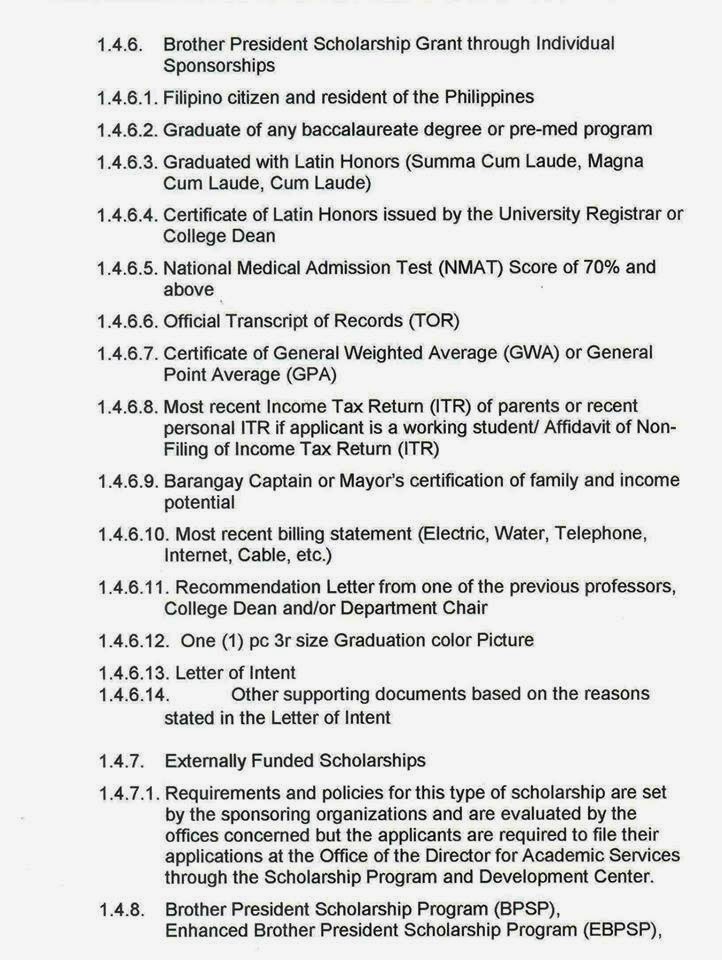
DLSHSI Scholarship Application Ongoing for SY 2014-2015

Hey guys, here's a sched of the application periods as well as the guidelines. :)

hope this helps! Good luck and God bless!


Wednesday, May 8, 2013

SURVIVING YOUR FIRST YEAR IN MEDICINE: tips and motivation

So. I survived my first year in Medicine.

http://www.wallpapersshop.net/wallpaper/this-is-sparta-300-king-leonidas-warrior-sword-shout-rage/

I was merely a few days away from freedom, and the final week was just pure torture. Everybody was feeling it, everyone was tired, sleepy, cranky, and just ready to get the exams over and done with. I wouldnt be surprised if a lot just kinda gave up on trying to finish reviewing everything, because, honestly, everyone seemed too tired to care.

BUT, we were always reminded, "ONE.LAST.PUSH."

One last push, and then summer vacation.
One last push, and you could burn all your reviewers and dance for joy.
One last push, and then you could sleep and eat as much as you wanted.

I was lucky though, I was exempted from several of the final exams, and it was such a relief that I didnt have to review all that bull-- and just relax at home.

I salute those who are still going to take the final exams and even removals. I seriously dont know how they hve the willpower to study all those topics all over again.

Honestly, I think that those who took the finals and removals have a headstart for the 2nd year, meaning, they have experienced the failures necessary to make them stronger and sturdier for the upcoming years.
I'm happy that I didn't fail any of the major exams in any subject this year, but I'm terrified about the upcoming failures I will be experiencing in the following years.

I don't know how to cope with failure. The one time that I "thought" I failed in an exam (I learned later on that I passed since they lowered the passing rate), I reacted like an immature piece of (expletive). I was depressed for several days, I was always thinking about how I would tell this to my parents, I thought how stupid was I to fail an exam?

I know, it seems a bit extreme for one exam, but Im just describing how terribly ill adapted I was to failure.

Looking back on the past year, I think I could have handled certain situations a lot better, especially in my academic life... so here are a few tips and words of wisdom to remember in surviving your first year:


1. In situations where you fail, remember this...you are not stupid, you are just adjusting.


from soulhunting.tumblr.com

This is Medicine. This isnt like your elementary/highschool/ college years where you could sleep, eat, poop normally, study for an exama night before and pass. There will be classmates who are smarter than you. They will ace every exam, every subject, they will UNDERSTAND EVERY WORD THE DOCTOR/LECTURER WILL SAY DURING LECTURES ( this is an astounding feat...), in all aspects, they are the ones who Darwin described when talking about survival.

BUT, then there is the rest of the class. Try talking to them. You will not be alone in your struggles. Take the time to look around and see that not everyone is doing so good in class. They may be honor students, summa cum laudes at their school, the math whiz, the top notcher in the Nursing/ PT/ RT/ OT/ Pharma boards.

Remember, this is Medicine. What matters is how YOU answer the challenge.
In the end, its just YOU who will be facing the patient.
It will be YOU handling the situation when you come face to face with a dying patient.


Pinned Image
http://pinterest.com/pin/247557310737728706/

Do what you have to to survive (except cheat, and other dishonorable means) in Medicine. Challenge yourself. Stop comparing.


2.Study when you have the free time.

Believe me when I say this. If the exam is a week away and you have a free day/ ISP (individual study period)/ weekend---study. One night--even one day--is not enough to cover all the topics you need to study for the upcoming exam.

Pinned Image
http://media-cache-ak1.pinimg.com/550x/71/a1/37/71a13761fdcc0dc0192bc982f1625025.jpg

3. When faced with setbacks (take note...setbacks, not failures):

Pinned Image
http://pinterest.com/pin/247557310736795482/
4. Within your first few months, try to find out your most efficient study habits.

http://edufastonline.blogspot.com/2012/09/your-learning-preference.html

Know whether you best retain info by reading, listening to lectures, studying while moving around, etc.
If you dont know, try experimenting in your first few months. After a few exams, you'll finally settle into your natural academic groove for studying.

5. Don't be afraid to FAIL.

I've yet to successfully pick up on this, and one I'm hoping I can conquer this coming 2nd year in Medicine. If you've already covered this one, good for you. Hahahahaha

What doesn't kill you makes you stronger. 

Medicine is like Jigsaw in the SAW movie, you never know what you're getting into, or what you have to exchange for freedom/ success/ a passing grade. 

I wanna play a game...its called....STUDYING.